
Choosing the right toilet partition height typical for your facility affects both privacy and compliance. Most commercial restrooms use 58-inch partitions, but specific requirements vary by location and use case.
We at Partition Stalls see facilities struggle with height decisions that impact user comfort and regulatory compliance. Understanding standard measurements helps you make informed choices for your restroom project.
Understanding Standard Toilet Partition Heights
ADA Compliance Sets the Foundation
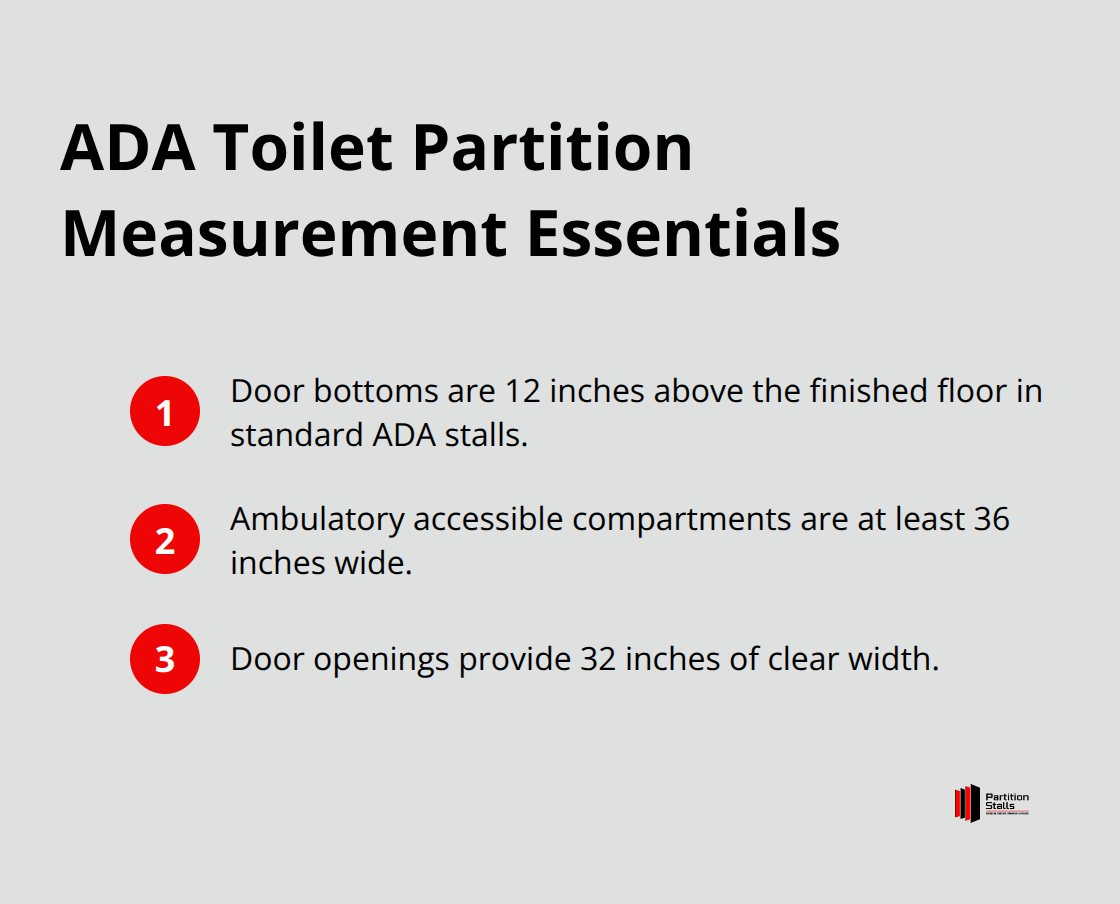
The Americans with Disabilities Act establishes specific height requirements that override local preferences. ADA Standards require that unisex toilet rooms, where provided, have privacy latches and contain at most one lavatory, one water closet, and one urinal. The critical measurement involves clearance above the finished floor rather than total partition height. Standard ADA installations position doors 12 inches above the floor, while ambulatory accessible compartments require 36-inch minimum widths with 32-inch door openings.
Industry Standards Vary by Manufacturer
Commercial restroom heights range from 55 to 72 inches based on privacy needs and manufacturer specifications. Hadrian’s Standard Series measures 58 inches while their Elite Series reaches 64 inches. Scranton Products offers three distinct options at 55, 62, and 71.5 inches for their Eclipse line. Solid plastic options like Hiny Hiders feature 55-inch panels with doors mounted 14 inches above floor level (providing enhanced durability). These measurements directly impact user privacy and facility maintenance protocols.
Facility Type Determines Height Selection
Healthcare facilities typically choose 72-inch partitions for maximum privacy, while office buildings often select 58-inch standards for cost efficiency. Schools prefer 62-inch heights to balance supervision needs with student privacy. High-traffic venues like airports and stadiums opt for 64-inch installations to reduce vandalism and improve durability. Restaurant restrooms commonly use 55-inch partitions to facilitate cleaning while they maintain adequate privacy for customers.
Local Building Codes Add Complexity
Municipal regulations often impose additional height requirements beyond federal ADA standards. A compliant lavatory is permitted on the rear wall 18 inches minimum from the water closet centerline if the clearance at the water closet is at least 66 inches. Some jurisdictions mandate minimum 60-inch heights for all commercial installations, while others allow 55-inch partitions in specific facility types. Fire codes may restrict floor-to-ceiling options in certain buildings (particularly those without sprinkler systems). These local variations make professional consultation valuable when you plan new installations or renovations.
Several factors beyond basic compliance shape your height selection decisions, from privacy concerns to maintenance efficiency.
Factors That Influence Partition Height Selection
Privacy and Security Drive Height Decisions
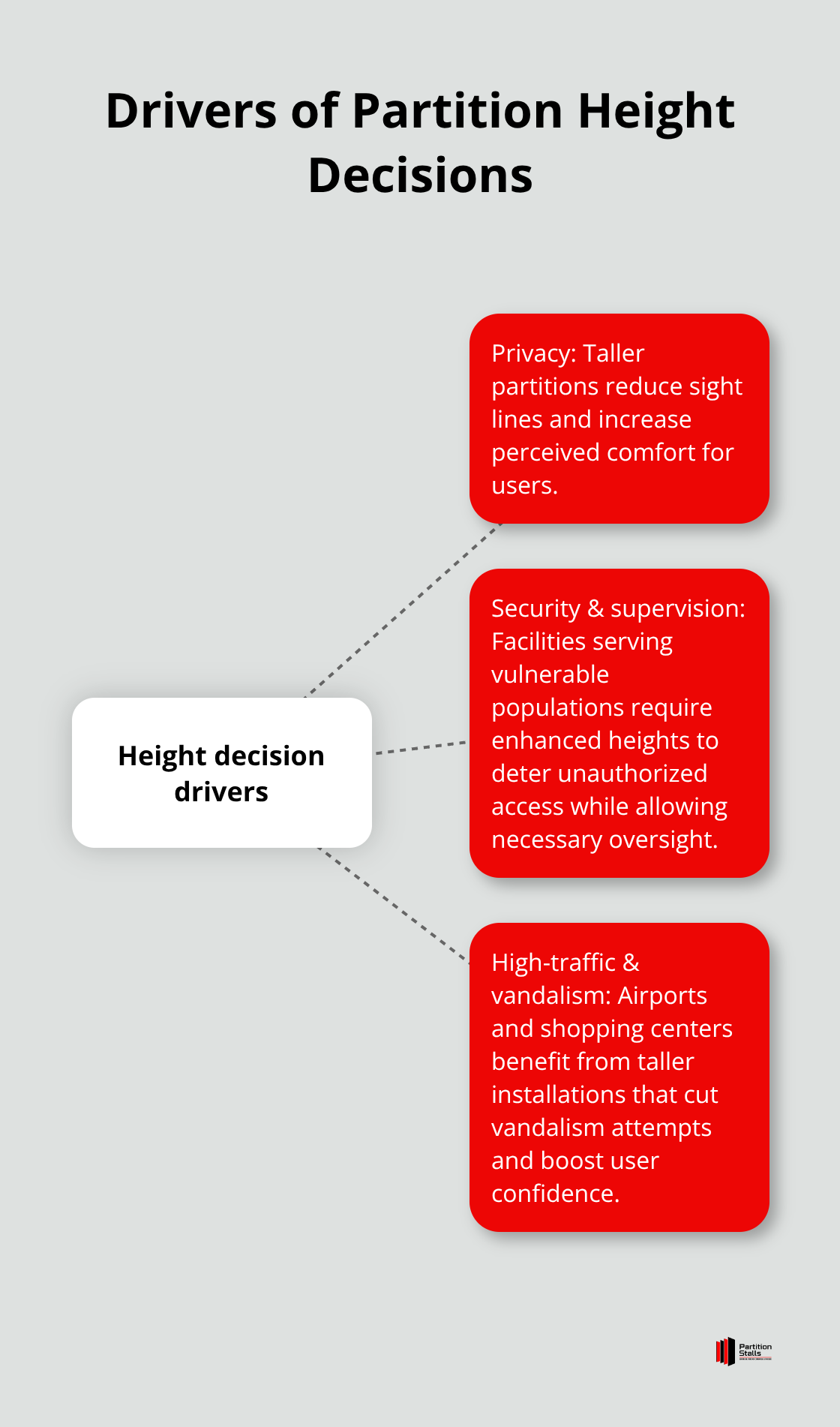
Privacy concerns top the list when you select partition heights, but security needs often override comfort preferences. Facilities that serve vulnerable populations like schools and healthcare centers require enhanced heights to prevent unauthorized access while they maintain necessary supervision. High-traffic venues including airports and shopping centers benefit from taller installations that reduce vandalism attempts and improve user confidence.
Office buildings can optimize costs with standard partitions, but executive floors often upgrade to higher options for enhanced privacy. Research from facility management studies shows that inadequate privacy heights generate more user complaints than properly sized installations.
Maintenance Access Changes Everything
Maintenance efficiency directly correlates with partition height selection, making this factor non-negotiable for facility managers. Standard partitions with proper floor clearance allow efficient maintenance and sanitization, which reduces time compared to floor-mounted alternatives.
Solid plastic partitions offer superior durability in high-moisture environments but require specialized protocols. Healthcare facilities that choose higher heights must install additional ventilation systems to prevent moisture buildup that damages wall surfaces.
Code Compliance Varies Dramatically
Local codes impose height restrictions that vary significantly between jurisdictions, making research essential before you finalize specifications. Fire marshals in major cities like New York and Chicago prohibit floor-to-ceiling partitions in buildings without sprinkler systems.
California regulations establish specific requirements for commercial restrooms, while other states allow different installations in retail environments. International Code requirements specify different height standards for assembly occupancies versus office buildings, with assembly spaces that require enhanced privacy measures. Municipal inspectors reject installations that exceed local height limits, which causes costly delays and reinstallation expenses.
These height requirements work together with specific measurements that manufacturers offer to create your final partition solution.
Common Height Options and Their Applications
Standard 58-Inch Partitions Dominate Commercial Applications
Most commercial facilities select 58-inch partitions because they balance cost, privacy, and maintenance efficiency effectively. Hadrian’s Standard Series at this height serves office buildings, retail stores, and restaurants while it meets basic privacy requirements. These installations cost approximately 25% less than elevated options and allow standard maintenance protocols that reduce long-term operational expenses. Office complexes with 58-inch partitions report fewer user complaints compared to shorter alternatives, while maintenance teams complete tasks 15% faster due to optimal clearance space.

70-Inch Heights Transform High-Privacy Environments
Healthcare facilities, executive offices, and upscale restaurants require 70-inch partitions to meet user expectations for enhanced privacy. Scranton Products’ 71.5-inch Eclipse partitions virtually eliminate sight lines while they maintain ADA compliance through proper door placement. These installations cost roughly 40% more than standard heights but generate significantly higher user satisfaction scores in privacy-sensitive environments. Healthcare facilities that use 70-inch partitions report improved patient comfort, as privacy remains important for patient satisfaction and regulatory compliance.
Floor-to-Ceiling Solutions Provide Ultimate Privacy
Maximum privacy applications demand floor-to-ceiling partitions that eliminate all gaps and sight lines between stalls. These installations work best in high-security facilities, executive washrooms, and premium hospitality venues where privacy expectations exceed standard commercial requirements. Installation costs increase by 75-100% over standard options, but facilities report near-zero privacy complaints and enhanced user confidence. Fire code restrictions limit floor-to-ceiling options in buildings without sprinkler systems, which requires careful coordination with local authorities during planning phases. Solid plastic materials perform best in these configurations due to superior durability and moisture resistance over 30-year lifespans (particularly in high-moisture environments).
Final Thoughts
You must balance privacy needs, compliance requirements, and maintenance efficiency when you select the toilet partition height typical for your facility. Standard 58-inch partitions serve most commercial applications effectively, while healthcare and executive facilities benefit from 70-inch options. Floor-to-ceiling installations provide maximum privacy but require careful fire code consideration.
Professional installation prevents costly mistakes and compliance issues. Incorrect measurements or improper mounting compromise structural integrity and violate local regulations. Expert installers understand ADA requirements, local codes, and manufacturer specifications that affect long-term performance.
We at Partition Stalls specialize in commercial restroom solutions that combine functionality with aesthetic appeal. Our team provides guidance through height selection, material choices, and customization options for offices, gyms, restaurants, and public facilities (tailored to your specific requirements). We offer consultations to help you choose the right partition height and create welcoming restroom environments.