Getting standard toilet partition dimensions right makes the difference between a restroom that works and one that frustrates users. Building codes, accessibility requirements, and space constraints all play a role in determining what fits your facility.
At Partition Stalls, we’ve helped countless businesses and institutions navigate these specifications to create functional, compliant restrooms. This guide breaks down the measurements and factors you need to know.
What Are the Standard Dimensions for Toilet Stalls
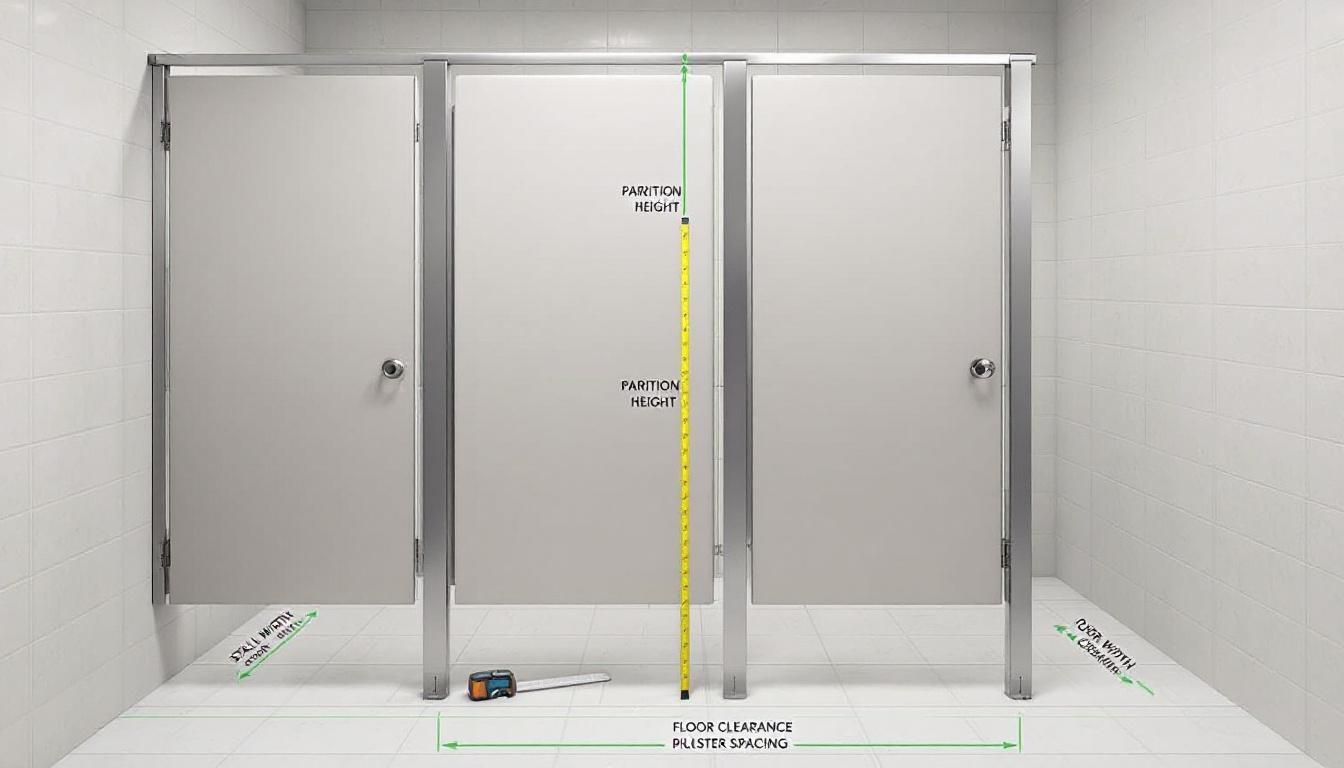
Standard toilet stalls measure 36 inches wide by 60 inches deep with a 24-inch door opening. These baseline dimensions work well for most commercial restrooms because they balance user comfort with space efficiency. The 36-inch width allows users to move without wasting floor space, while the 60-inch depth accommodates the toilet fixture and permits someone to stand and move around. The 24-inch door provides adequate access without requiring excessive clearance in front of the stall.
Not all stalls follow this standard, and understanding when to deviate matters significantly for your project. ADA-compliant stalls operate under different rules entirely. According to U.S. Access Board guidelines, an accessible stall requires a minimum inside width of 60 inches and inside depth of 56 inches, with a 36-inch outward-swinging door. The toilet itself must sit no more than 4 inches from the corner, and the centerline must measure 18 inches from the nearest wall or partition. These requirements exist because wheelchair users need substantially more maneuvering space than ambulatory users. Most facilities position the ADA stall at the end of the row to maximize the available space without sacrificing standard stalls elsewhere in the restroom.
Height Requirements for Doors and Panels
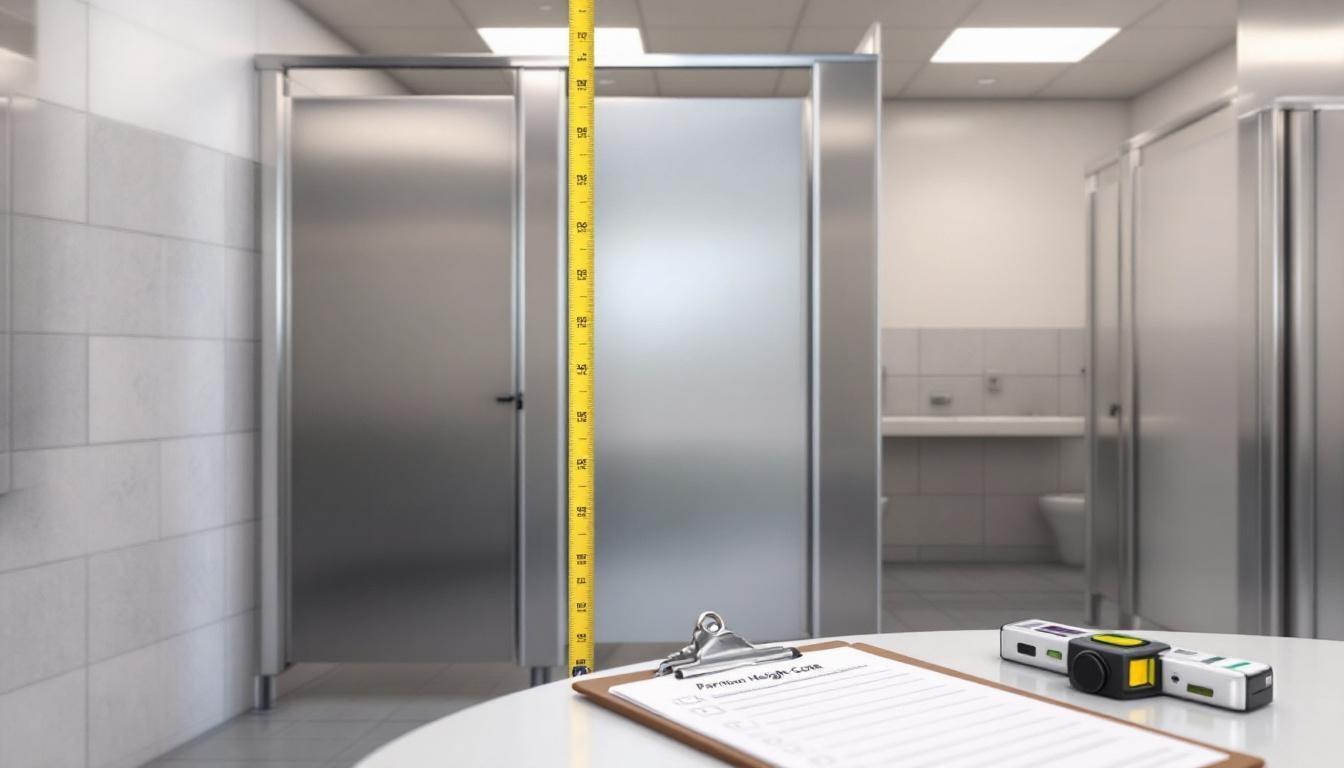
Standard doors and side divider panels typically stand 58 inches tall, mounted 12 inches off the floor. This height strikes a practical balance between privacy and safety. A 58-inch door prevents someone from looking over the top while still allowing staff to see if someone needs help. The 12-inch gap at the bottom serves multiple purposes: it provides visual confirmation that a stall is occupied, allows for easier cleaning underneath, and prevents the uncomfortable feeling of complete enclosure.
For facilities requiring extra privacy, doors can reach 71.5 inches and panels up to 76 inches, though this increases cost and reduces the practical benefits of the floor gap. Solid plastic partitions differ slightly, using 55-inch high side divider panels mounted 14 inches from the floor. The overall support structure typically includes 82-inch tall pilasters with overhead rail bracing at the top, providing the structural stability needed for high-traffic environments.
Installation Methods and Ceiling Considerations
Floor-mounted partitions with overhead bracing represent the most common installation method. Ceiling-hung systems can accommodate taller setups, reaching practical maximums around 123.5 inches, while floor-to-ceiling braced partitions offer maximum stability for heavy-use areas supporting ceilings up to about 122 inches. Your ceiling height and traffic patterns determine which installation method works best for your space.
Depth Variations and Space Planning
While 60 inches serves as the standard depth, actual requirements vary based on your specific layout and privacy expectations. Minimum depth sits at 48 inches, though this creates a tight fit that many users find uncomfortable. Maximum practical depth reaches 78 inches, which works well for facilities prioritizing privacy or serving users with mobility devices. The depth determines how far someone can stand back from the toilet, affecting both comfort and the ability to use grab bars effectively.
Stall width similarly demands attention beyond the standard 36 inches. Ambulatory accessible compartments require at least 36 inches wide with a handicap door typically around 32 inches, designed specifically for users who need grab bars and stability but can stand independently. When you plan your restroom, overhead drawings showing walls, compartment widths and depths, overall between-wall dimensions, and optional toilet bowl centers produce the most accurate quotes. Most partitions cannot be field-cut, making precise measurements essential before ordering. Standard layouts commonly feature 3-foot compartments, though custom layouts often work without significant cost premiums.
The specifications you select directly impact how your restroom functions and how users experience the space. Material choices and regional building codes add another layer of complexity to these dimension decisions.
What Drives Your Partition Dimensions
Regional Building Codes Shape Your Options
Building codes vary significantly across regions, and this variation directly impacts the dimensions you can or must use. The ADA Standards for Accessible Design apply nationwide, but states and municipalities layer additional requirements on top. Some jurisdictions mandate that a certain percentage of stalls meet ambulatory accessible standards in addition to wheelchair-accessible compartments. For example, the ADA requires ambulatory accessible compartments in toilet rooms with six or more fixtures, which means your restroom layout cannot simply repeat the standard 36-inch-wide stall. California’s Title 24 energy code and some local accessibility ordinances push further than federal minimums. Before you finalize partition dimensions, contact your local building department and request their specific toilet room requirements. Most building officials provide written guidance in under a week, preventing costly redesigns after ordering. Regional differences matter enough that a 60-inch-deep stall acceptable in one state might violate setback or clearance rules in another.
Space Constraints Force Creative Solutions
Space constraints force the most difficult compromises in partition planning. An existing restroom rarely offers ideal dimensions, and retrofits demand creative solutions that standard off-the-shelf partitions cannot address. If your facility has walls positioned 105 inches apart, standard 3-foot compartments with typical pilaster widths will not fit cleanly-you either shrink compartments to 34 inches (uncomfortable for most users) or accept awkward spacing. This is where custom layouts become practical rather than luxurious. The cost difference between a standard three-stall configuration and a customized layout designed for your exact wall spacing is often negligible, typically under 5 percent. Provide overhead drawings to your supplier showing exact wall-to-wall dimensions, because guessing creates expensive problems during installation.
User Demographics Determine Practical Dimensions
User demographics shape dimension choices in ways many facility managers overlook. A gym targeting older adults benefits from wider stalls (40 to 42 inches) and grab bars positioned at 33 to 36 inches above the floor rather than the standard 30-inch height. Healthcare facilities serving patients with mobility devices need deeper compartments (70+ inches) to accommodate walkers and canes. Schools with elementary-age children can use slightly reduced heights and narrower door widths without sacrificing safety. Gender-neutral single-occupant restrooms increasingly replace multi-stall facilities in modern construction, which eliminates partition dimension questions entirely but requires different accessibility planning. The ADA provides non-mandatory advisory dimensions for different age groups (3-4, 5-8, 9-12 years old) covering water closet centerline, seat height, grab bar height, and dispenser height. Selecting the right dimensions for your actual user base produces higher satisfaction and lower maintenance issues than defaulting to one-size-fits-all specifications.
Material choices and regional building codes add another layer of complexity to these dimension decisions, which we explore in the next section.
Customization Options for Your Restroom Space
Material selection fundamentally changes how partitions function and what dimensions actually work for your facility. Facility managers often make material decisions based on cost alone, then struggle with dimensions that don’t perform in their specific environment. Powder-coated steel partitions cost the least upfront, typically 30 to 40 percent less than solid plastic alternatives, but they use a honeycomb cardboard interior that becomes problematic in humid bathrooms. The steel exterior measures 1 inch thick for panels and doors, with 1.25-inch pilasters providing structural support. However, moisture penetration through the cardboard core creates swelling and deterioration within five to seven years in high-humidity environments like pools or spas. Solid plastic HDPE partitions cost more initially, running 40 to 50 percent higher than steel, but deliver a 30-plus-year lifespan in the same conditions.
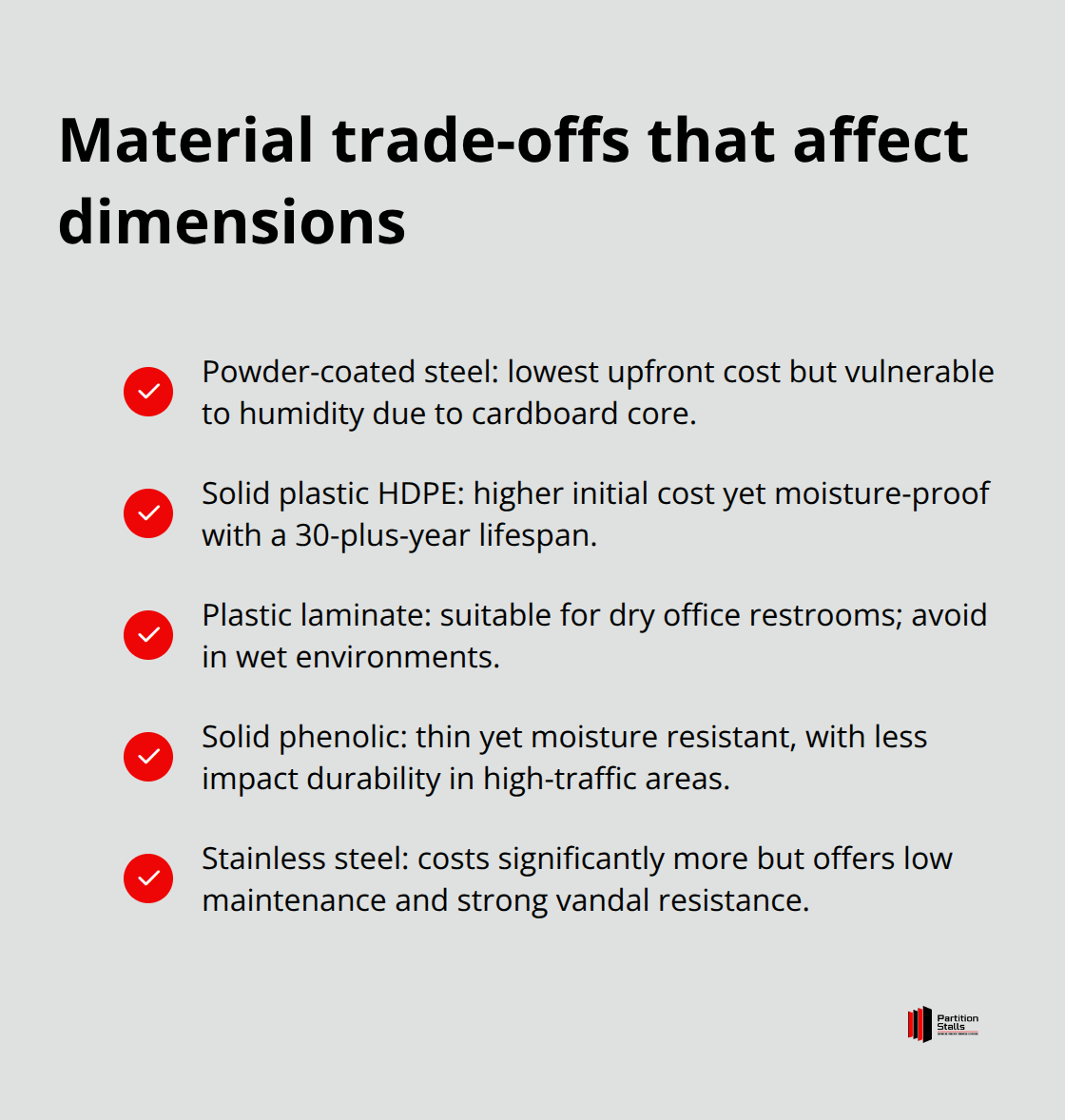
The material measures 1 inch thick throughout with no moisture-absorbing core, making it the only realistic choice for gyms, locker rooms, and facilities where humidity exceeds 60 percent regularly.
Material Choices and Their Impact on Dimensions
Plastic laminate partitions using Formica or Wilsonart materials bond to particleboard in high-pressure processes, creating a 1-inch-thick panel suitable for standard office restrooms but inadequate for wet environments. Solid phenolic panels measure only 0.5 inches thick with 0.75-inch doors, reducing material cost while maintaining moisture resistance, though the thinner construction means less impact durability in high-traffic areas. Stainless steel partitions in 304 grade with a number-four brushed finish cost 60 to 80 percent more than steel but require virtually no maintenance and resist vandalism effectively. Your material choice directly determines what dimensions work practically. A standard 36-inch-wide stall performs adequately with powder-coated steel in an office but feels cramped with solid plastic in a gym where users wear bulkier clothing and need grab bars mounted at non-standard heights.
Hardware and Accessory Integration
Hardware integration and accessory placement create hidden dimension requirements that most facility managers discover too late. Grab bars must clear toilet paper dispensers by at least 12 inches according to ADA Standards, which means a side grab bar at 33 inches high cannot coexist with a standard toilet paper dispenser mounted at 48 inches without careful positioning. If you specify a recessed toilet paper dispenser, you reduce the required clearance significantly and free up space for properly positioned grab bars. Door hinges and latching mechanisms require specific pilaster widths to function correctly, with standard hinges needing 1.25-inch-wide pilasters while offset hinges work with narrower 1-inch pilasters. Coat hooks, shelves, and feminine hygiene product dispensers each occupy 4 to 6 inches of horizontal space within the stall, forcing dimension decisions about whether to mount them on the door, side panel, or back wall.
Optimizing Stall Width for Comfort and Function
A 36-inch-wide stall with a side grab bar, coat hook, and toilet paper dispenser all competing for wall space creates an uncomfortable experience. Increasing width to 40 inches solves this without the cost of a full ADA-compliant stall. The accessory layout should drive your dimension selection, not the reverse. Document exactly what accessories your facility requires, then work backward to determine the minimum stall width that accommodates all items safely and comfortably. Most custom layouts that exceed standard dimensions require careful planning to ensure proper functionality and user comfort.
Final Thoughts
Standard toilet partition dimensions work only when they match your facility’s actual conditions, user needs, and local codes. A 36-inch-wide stall fits perfectly in an office but feels cramped in a gym, while a 60-inch ADA-compliant width solves accessibility but consumes floor space. Your material choice, grab bar placement, and accessory requirements all shift what dimensions truly work for your space.
We at Partition Stalls understand how these variables interact in ways that generic specifications cannot address. Our team reviews your overhead layouts, recommends materials suited to your environment, and identifies dimension options that fit your exact constraints. We handle the technical complexity so your restroom actually serves your users instead of frustrating them.
Contact Partition Stalls for a free consultation and transform your restroom with solutions tailored to your specific needs.