Selecting the right bathroom toilet partition affects both functionality and user experience in commercial restrooms. Poor choices lead to frequent repairs, privacy complaints, and costly replacements.
We at Partition Stalls see businesses struggle with this decision daily. The right partition material and design can serve your facility for decades while meeting all regulatory requirements.
Which Partition Material Suits Your Commercial Space
Powder-Coated Steel Sets the Standard
Powder-coated steel partitions dominate commercial restrooms because they balance cost and performance effectively. These partitions start at approximately $275 per stall, which makes them the most budget-friendly option for most projects. The powder coat process creates a durable surface that is highly resistant to impacts and abrasions, maintaining its appearance in moderate-traffic environments.
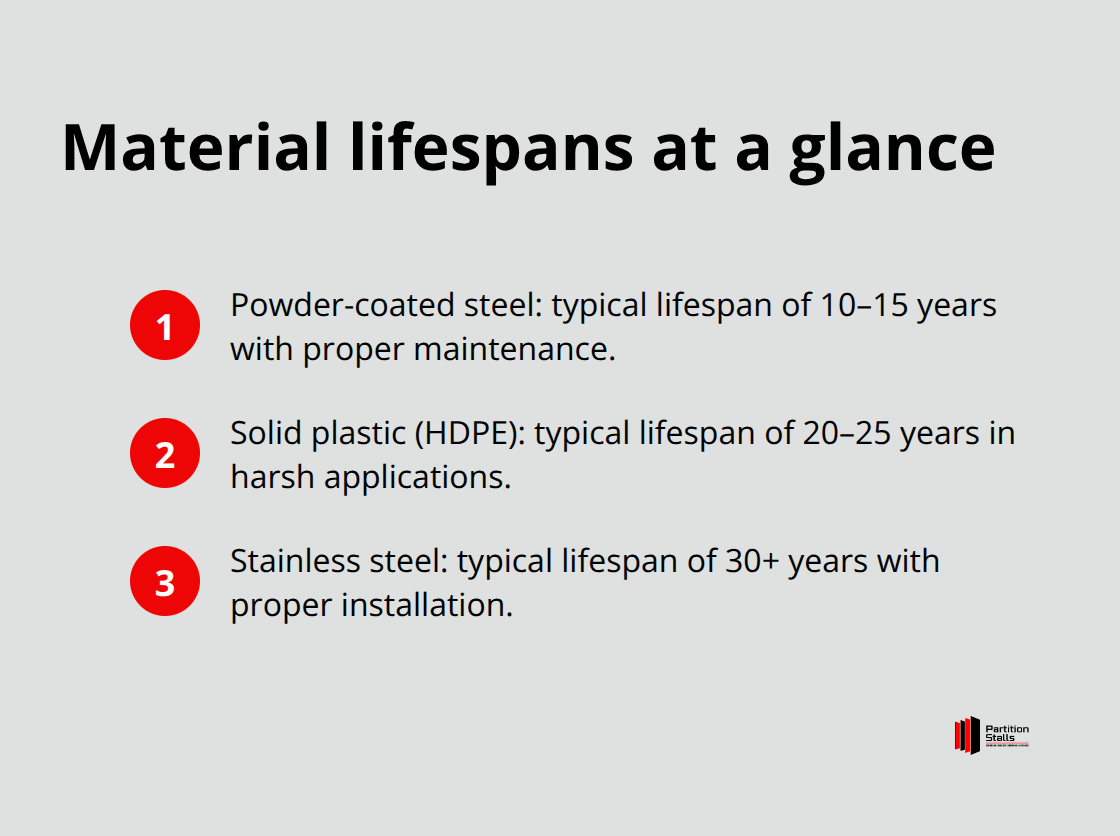
Steel partitions typically last 10-15 years with proper maintenance, though they show wear faster than premium materials in high-traffic locations. Schools and office buildings choose steel partitions for their reliability and straightforward replacement process when damage occurs. The material provides solid value for facilities that prioritize cost control over maximum durability.
Solid Plastic Delivers Unmatched Durability
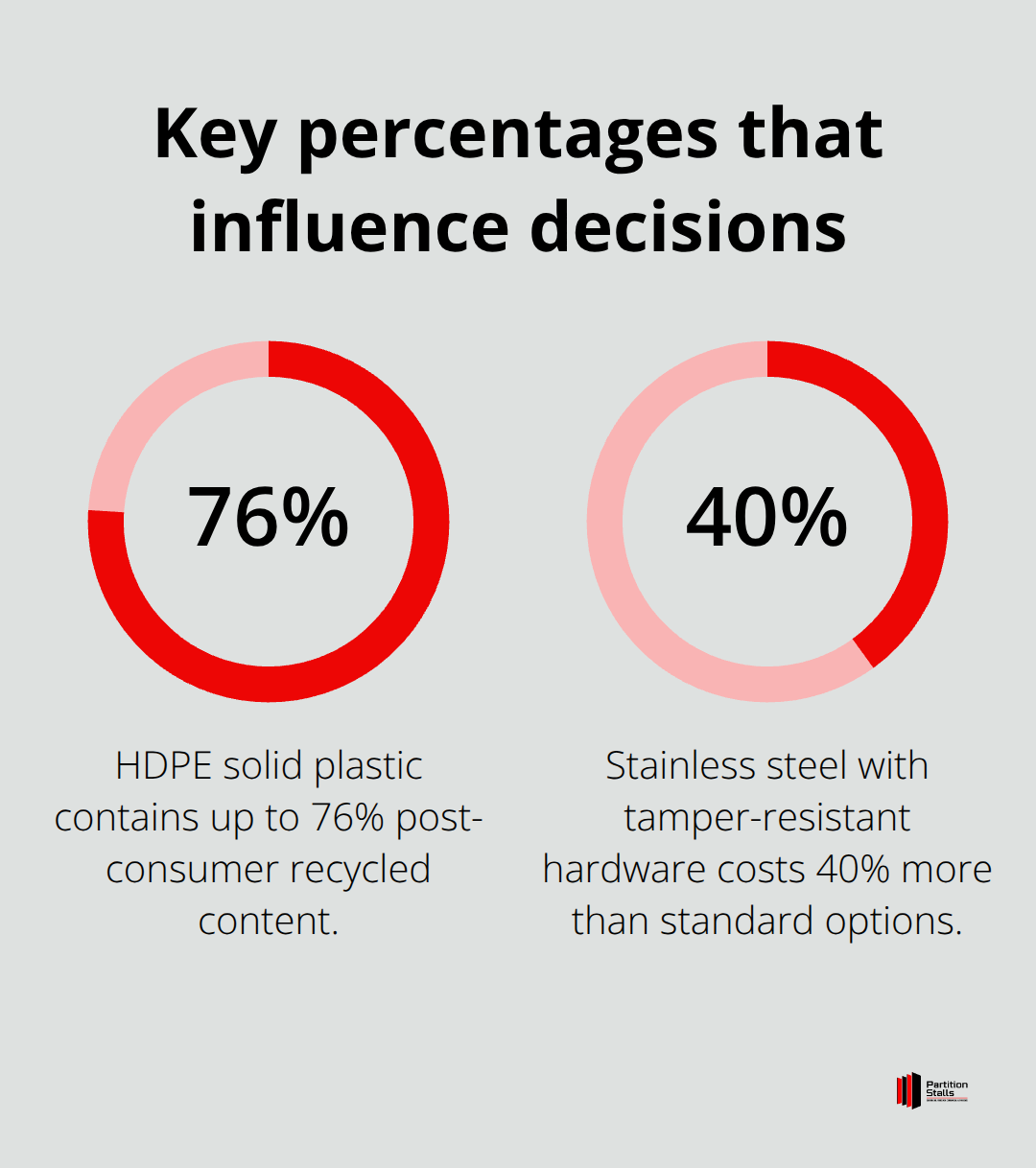
Solid plastic partitions (particularly HDPE options) contain up to 76% post-consumer recycled content while they provide exceptional graffiti resistance. These partitions withstand vandalism attempts that destroy other materials, which makes them the top choice for schools, transit facilities, and detention centers.
HDPE partitions are completely impervious to moisture and prevent the warp and mold issues that plague laminate options in humid environments. The material weighs significantly less than steel, which reduces installation complexity and labor costs. Solid plastic partitions command higher upfront costs but eliminate replacement expenses for 20-25 years in harsh applications.
Stainless Steel Represents Premium Performance
Stainless steel partitions offer the highest impact resistance and theft deterrence available in commercial restroom applications. The material’s non-porous surface prevents bacterial growth and simplifies clean protocols in healthcare and food service environments.
Stainless steel partitions typically include concealed latches and vandal-resistant security fasteners that prevent vandalism and theft attempts common with exposed hardware systems. These partitions carry Class A fire ratings and meet the strictest safety requirements for high-occupancy facilities. The premium price reflects superior longevity, with properly installed stainless steel partitions that serve facilities for 30+ years without replacement.
Your material choice directly impacts long-term maintenance costs and user satisfaction, but other factors also shape your partition selection process.
What Factors Drive Your Partition Selection
Traffic Volume Determines Material Performance
High-traffic restrooms require partitions that withstand consistent daily use without wear. Schools and transit facilities push standard powder-coated steel beyond its limits, which creates maintenance headaches within 3-5 years. Solid plastic partitions handle this abuse while they maintain their appearance for 20+ years.
Healthcare facilities with 24/7 operations need stainless steel partitions because they resist bacterial growth and support aggressive cleaning protocols with bleach-based disinfectants. Medium-traffic office buildings get excellent value from powder-coated steel, which serves 10-15 years before replacement becomes necessary.
Privacy Requirements Shape Design Decisions
Standard partitions leave 12-inch gaps at the bottom and 6-inch gaps between doors and frames, which creates privacy concerns in professional environments. High-privacy partitions reduce these gaps to 4 inches at the bottom and eliminate side gaps completely.
Law firms, medical offices, and upscale restaurants choose high-privacy designs to protect user comfort and professional image. Security features become critical in detention facilities and schools where concealed fasteners prevent vandalism and theft.
Budget Constraints Impact Long-Term Value
Stainless steel partitions with tamper-resistant hardware cost 40% more than standard options but eliminate security breaches that compromise facility operations. Budget planning must account for these privacy and security upgrades because retrofitting existing installations costs three times more than initial proper specification.
Powder-coated steel partitions start at $275 per stall, making them the most economical choice for moderate-traffic applications. Solid plastic options command higher upfront costs but deliver 20-25 year lifespans that reduce total ownership expenses in demanding environments.
These material and feature decisions work together with proper space planning and regulatory compliance to create functional restroom environments.
How Do You Plan Restroom Layouts That Work
Meeting ADA Requirements Without Compromise
The ADA Standards require that unisex toilet rooms, where provided, have privacy latches and contain at most one lavatory, one water closet, and one urinal. Accessible toilet compartments require 60-inch diameter turning spaces or T-shaped clearances, which means standard 36-inch wide stalls fail accessibility requirements.
We recommend 60-inch wide accessible stalls as the minimum for wheelchair maneuverability, though 66-inch widths provide superior user comfort. The International Building Code requires accessible unisex restrooms in public spaces with six or more fixtures, which forces facilities to plan for both multi-user and single-user accessible options.
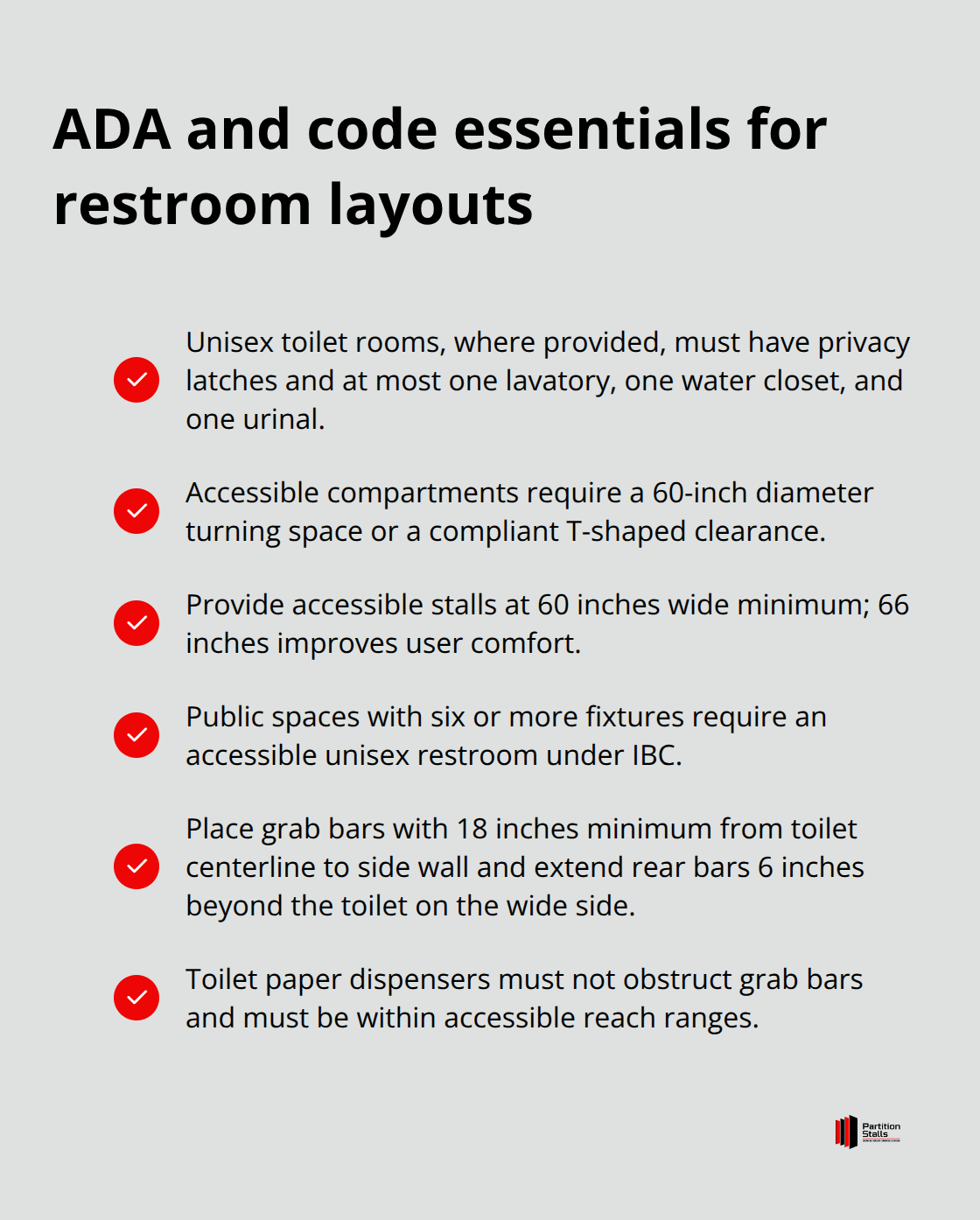
Grab bar placement must allow 18 inches minimum from the centerline of the toilet to the side wall, with rear grab bars that extend 6 inches beyond the toilet on the wide side. Toilet paper dispensers cannot obstruct grab bars and must deliver continuous roll flow within accessible reach ranges.
Space Efficiency Through Smart Design
Door swing direction determines space utilization in restroom layouts, with inward-swinging doors that require 18 inches of clearance beyond the door width for proper operation. Outward-swinging doors eliminate this space requirement but create corridor obstruction issues in narrow restroom designs.
Floor-mounted partitions work best in facilities with uneven floors or future renovation plans, while ceiling-hung systems maximize cleaning access underneath stalls. Standard 24-inch door widths meet most applications, but 32-inch doors become necessary for wheelchair access and emergency response situations.
Layout Planning Prevents Costly Mistakes
Pilaster spacing affects both structural integrity and user privacy, with 12-inch gaps between stalls that provide adequate privacy while maintaining cost efficiency. Professional layout planning prevents costly mistakes like insufficient turning radius or blocked emergency egress that require expensive modifications after installation.
Proper measurements must account for plumbing fixture locations, electrical outlets, and ventilation requirements before partition installation begins. Floor drains and slope considerations affect partition mounting options particularly in wet areas like locker rooms and pool facilities.
Final Thoughts
Your bathroom toilet partition choice affects facility operations for decades. Powder-coated steel partitions serve moderate-traffic environments at $275 per stall, while solid plastic options handle vandalism and moisture for 20-25 years. Stainless steel partitions provide premium durability and security for high-end applications that require 30+ year lifespans.
Traffic volume drives material selection more than initial cost considerations. Schools and transit facilities need solid plastic partitions to withstand daily abuse, while office buildings get excellent value from powder-coated steel. Healthcare facilities require stainless steel for infection control and aggressive cleaners (like bleach-based disinfectants).
ADA compliance demands 60-inch wide accessible stalls with proper grab bar placement and turn clearances. Professional layout plans prevent costly mistakes like insufficient space or blocked emergency egress that require expensive post-installation modifications. We at Partition Stalls provide expert guidance for commercial restroom solutions with durable partitions, grab bars, and accessories for your specific application and budget requirements.