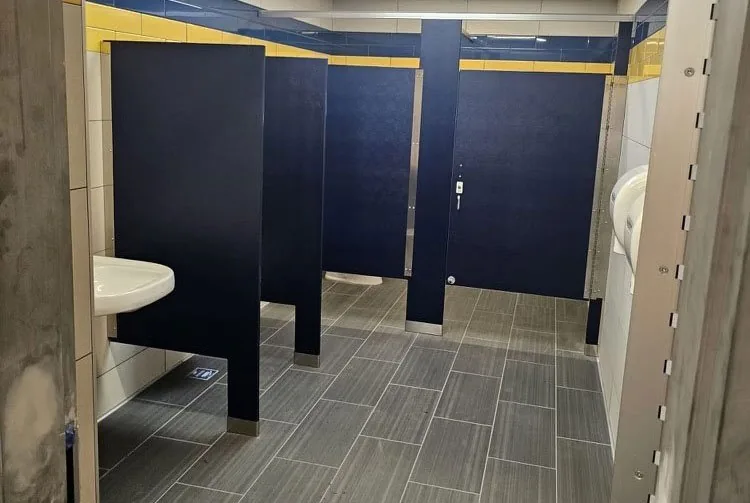
Partition Stalls supplies five core commercial partition material categories: powder-coated steel, plastic laminate, solid plastic HDPE, solid phenolic, and stainless steel. The right choice depends on moisture, cleaning methods, traffic, vandalism risk, appearance, accessibility details, and the manufacturer’s tested construction—not on a universal “best” material.
Use this guide to narrow the specification. Final thicknesses, fire-test classifications, hardware, mounting system, colors, lead time, and warranty are product-line specific and should be confirmed in the selected manufacturer’s current submittal.
Quick comparison
- Powder-coated steel: Often the lowest first-cost option for dry, supervised restrooms. A coating breach can expose steel to corrosion, so cleaning practices, edge details, shoes, and the environment matter.
- Plastic laminate (HPL): Decorative laminate over a substrate such as industrial-grade particleboard. Bobrick’s HPL example uses 1-inch doors, stiles, and panels and carries a Class B ASTM E84 classification; the substrate and edge treatment make moisture exposure an important design consideration. 1
- Solid plastic HDPE: A solid, color-through, non-absorbent material commonly specified for demanding wet-cleaning and high-traffic areas. Bradley’s Bradmar specification identifies HDPE as waterproof, non-absorbent, and graffiti-resistant, with 1-inch doors, panels, and pilasters in that product line. Fire classification and recycled content must be selected and verified for the actual product. 2
- Solid phenolic: Resin-impregnated paper compressed into a dense panel. A current Bradley phenolic example uses 1/2-inch panels and 3/4-inch doors and pilasters, and describes the material as non-absorbent, impact-resistant, and resistant to delamination under extreme conditions. Other systems may use different dimensions. 3
- Stainless steel: A corrosion-resistant metal finish used where a clean architectural or institutional appearance is desired. Grade, finish, core, gauge, and tested fire classification vary by system; request the manufacturer’s submittal rather than assuming every stainless partition has the same performance.
These are practical starting points, not universal rankings. For example, Bobrick’s catalog reports different ASTM E84 classifications across its own partition materials and notes that HDPE may require an unmodified NFPA 286 test where applicable. Confirm the governing code and the exact product documentation. 1
What materials are commercial toilet partitions made from?
The five core categories are powder-coated steel, plastic laminate, solid plastic HDPE, solid phenolic, and stainless steel. Color-through phenolic is a phenolic variant, not a separate sixth core category.
For a wet or frequently hosed restroom, start by comparing HDPE and phenolic systems. For a dry, supervised space where initial budget and color selection matter, powder-coated steel or laminate may be appropriate. For a more architectural finish, compare phenolic and stainless steel. These are screening recommendations; the project specification, cleaning program, code requirements, and manufacturer data control.
What are powder-coated steel toilet partitions?
Powder-coated steel partitions use formed steel components with a baked finish. They are commonly considered for dry, light-to-moderate-use restrooms because they offer color choices and can be economical. Corrosion resistance depends on the coating system, fabrication, exposed edges, hardware, cleaning, and environment. Do not treat “powder-coated steel” as a single construction: request the product’s gauge, core, coating, and corrosion documentation.
A stainless shoe or other corrosion-resistant detail may be appropriate in a wet or corrosive environment, but it is not a substitute for selecting a system suitable for that environment. Confirm the complete assembly with the manufacturer.
What are solid plastic HDPE toilet partitions?
HDPE partitions are solid high-density polyethylene panels with color throughout. A current Bradley specification describes its HDPE panels as waterproof, non-absorbent, and graffiti-resistant, and specifies 1-inch doors, panels, and pilasters for that product line. 2 Scranton’s comparison describes 1-inch HDPE panels as color-through and reports product-specific testing for mold and mildew resistance; that result should not be generalized to every HDPE product without its test documentation. 4
HDPE is often a strong candidate for schools, locker rooms, parks, and other areas with wet cleaning or heavy traffic. Surface texture, hardware, edge details, fire classification, and warranty vary. Do not assume that standard HDPE passes a particular fire test; select a documented grade when the code or project specification requires it. Avoid placing any plastic partition beside an unapproved heat source, and follow the selected manufacturer’s installation and clearance instructions.
What are plastic laminate toilet partitions?
Plastic laminate partitions use high-pressure decorative laminate over a substrate. Bobrick identifies its HPL construction as high-pressure laminate with a 45-pound-density industrial-grade resin-impregnated particleboard substrate and 1-inch doors, stiles, and panels. 1
Laminate can provide woodgrain and pattern choices in a dry, maintained restroom. Because the substrate and edge treatment are part of the system, repeated water exposure, hose cleaning, or standing moisture should trigger a product-specific suitability review. Do not rely on a generic “waterproof” or “dry area” label without reading the selected manufacturer’s specifications.
What are solid phenolic toilet partitions?
Solid phenolic is made from resin-impregnated paper compressed into a dense panel, usually with a decorative surface. In Bradley’s PH600 ceiling-hung example, panels are 1/2 inch thick and doors and pilasters are 3/4 inch thick. The same document describes the product as non-absorbent, impact- and graffiti-resistant, and resistant to steam, soaps, detergents, and mildew. 3
Phenolic is worth comparing for high-traffic or humid projects that also need a refined decorative finish. Black-core and color options, edge appearance, panel dimensions, mounting, fire documentation, and warranty differ by product. “Waterproof,” “Class A,” and similar terms should be used only when supported by the selected product’s current data sheet or test report.
What are stainless steel toilet partitions?
Stainless steel partitions use stainless components in a manufacturer-specific assembly. Ask for the stainless grade, finish, thickness or gauge, core construction, hardware, and fire-test documentation. Type 304 is common in many interior applications, while a more corrosion-resistant grade may be considered for some coastal or chlorine-exposed conditions; the manufacturer and project engineer should confirm suitability.
A satin or textured finish can change the appearance and maintenance profile, but no finish makes a partition dent-proof or scratch-proof. Stainless is often selected for an architectural, institutional, or high-traffic appearance, with cost and dent repair considered during design.
Which toilet partition material is the most affordable?
Powder-coated steel is often positioned as a lower first-cost category, but actual pricing depends on layout, mounting style, privacy height, hardware, color, freight, and installation. Laminate, HDPE, phenolic, and stainless pricing also varies by product and project. Partition Stalls’ current automatic pricing scope is powder-coated steel only; the other material categories are quote-first.
Use the Toilet Partition Cost Guide for planning context, not a formal quote. Material planning ranges exclude installation and freight unless specifically stated. Request a project-specific quote for exact pricing.
Which toilet partition material is the most durable?
“Durable” depends on the threat. Solid HDPE and phenolic avoid an absorbent wood-based core, while stainless can be a strong corrosion-resistant choice. Powder-coated steel can be practical in a dry, supervised room but needs protection from coating damage and corrosive exposure. Laminate can perform well in suitable dry interiors but should not be specified for repeated wet exposure without product documentation.
Compare the selected system for impact, abrasion, graffiti, cleaning chemicals, moisture, fire testing, hardware, and warranty. Manufacturer test results are more reliable than a universal service-life number. Do not assume predictable 10–30-year service lives or that one material lasts “twice as long”; service life depends on product, use, maintenance, installation, and environment.
Which toilet partitions are best for wet environments?
Solid HDPE and solid phenolic are logical categories to compare for wet or humid environments because the cited product examples are non-absorbent. 2 Stainless may also be appropriate when the selected grade and assembly suit the exposure. Laminate and powder-coated steel require closer review of the substrate, coating, edges, hardware, cleaning, and water exposure.
The mounting system matters too. Ceiling-hung, floor-to-ceiling, and overhead-braced systems have different structural and floor-clearance requirements. Stainless hardware may be appropriate in a corrosive environment, but specify it as part of the complete system rather than assuming that one hardware upgrade solves every exposure issue.
Which toilet partition material is best for schools?
There is no single school standard. HDPE is often evaluated for student restrooms because solid, color-through construction and wet-cleaning resistance can fit demanding use. Phenolic may fit projects seeking a decorative finish and non-absorbent construction. Powder-coated steel or laminate may fit dry, supervised staff areas when allowed by the project standard.
Review the district’s Division 10 requirements, accessibility details, fire documentation, mounting and anchorage, cleaning products, vandalism expectations, and warranty before pricing. Select full-height or heavy-duty hardware only when it is part of the chosen manufacturer’s tested and specified system.
Which material is best for upscale office buildings and hotels?
Phenolic and stainless are common categories to compare when appearance, privacy options, and maintenance matter. Laminate can offer woodgrain and decorative patterns in a suitable dry restroom. The right choice still depends on the selected finish, privacy design, cleaning program, fire documentation, and budget; “Class A” or “premium” should not be assumed from the material name alone.
Are HDPE partitions better than powder-coated steel?
HDPE is often the stronger starting point for wet cleaning, high traffic, and vandalism concerns. Powder-coated steel can be a practical lower-first-cost choice for dry, supervised use. Neither statement makes one material universally better. Compare the actual products for impact, corrosion, graffiti, fire testing, hardware, warranty, and total project cost.
Is phenolic better than HDPE?
Neither is universally better. Phenolic can offer a dense decorative surface and slim options in some product lines. HDPE can offer solid color-through construction and non-absorbent panels in documented systems. Compare texture, abrasion and impact data, fire testing, cleaning compatibility, colors, edge appearance, mounting, and warranty for the actual products.
Is stainless steel better than powder-coated steel?
Stainless may be preferable when the design calls for a metal architectural finish or when corrosion resistance is important, but grade, finish, core, and exposure still matter. Powder-coated steel may be appropriate where initial budget and color selection are priorities in a dry, lower-abuse restroom. Compare the complete assemblies and project-specific pricing instead of assuming a fixed cost multiple or service life.
Which toilet partition material provides the best overall value?
Value is the balance of purchase price, freight, installation, cleaning, repairs, replacement risk, appearance, and expected service under the actual conditions. A simple planning comparison is:
Estimated annual ownership cost = (initial installed cost + expected repairs over the service period) ÷ expected service years
This is a planning model, not a promise or a verified life-cycle estimate. Use comparable project quotes, realistic repair and service-period assumptions, and the selected manufacturer’s warranty and maintenance instructions.
Next steps with Partition Stalls
Partition Stalls supplies nationwide. Supply-and-installation availability is project-specific and should be confirmed for projects in the states where installation review is offered. Material selection, dimensions, accessibility, anchorage, fire requirements, freight, and installation should be confirmed before ordering.
Related reading: ADA and code requirements; Manufacturer comparison; Plastic laminate.
References